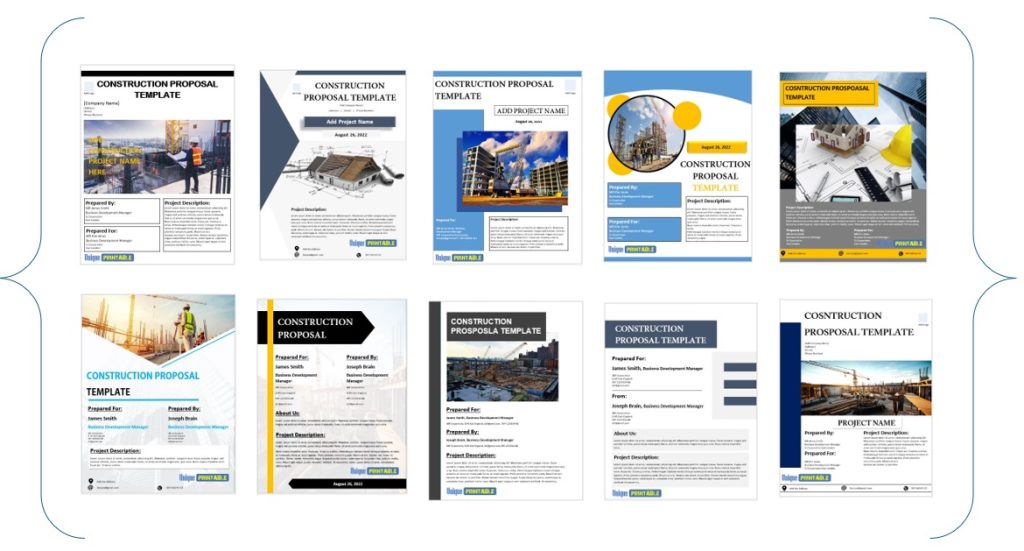
A land development proposal sets out what you intend to build on a site, how it will be delivered, what it costs and why it should be approved. Depending on the reader it is a pitch to a landowner, a submission to a planning authority, or the document a lender assesses before committing finance.
Below are 10 free land development proposal templates in MS Word. They cover residential subdivision, commercial schemes, feasibility studies, phasing plans and development budgets. All sections are editable, so you are adding site-specific detail rather than building the structure from scratch.
1. Standard Land Development Proposal

The full structure: site description, proposed scheme, programme, costs, team and approvals needed. Start here if you have not written one before, since it covers what most readers expect to find.
MS WORDDownload Now ↓
2. Residential Subdivision Proposal

Plot count and sizes, road and access layout, utilities and open space provision. Built for dividing a parcel into residential lots, where the density and access arrangements are what get scrutinised first.
MS WORDDownload Now ↓
3. Commercial Development Proposal

Floor area, intended use, parking provision and anticipated tenants or occupiers. For retail, office or mixed-use schemes, where the commercial case matters as much as the design.
MS WORDDownload Now ↓
4. Site Feasibility Study

Site constraints, access, services, an options appraisal and a viability conclusion. The document that comes before the proposal proper, and the one that should be allowed to conclude that a site does not work.
MS WORDDownload Now ↓
5. Planning Application Supporting Statement

Structured around justifying the scheme: how it sits against local policy, its design rationale and its effect on neighbours and infrastructure. Requirements vary considerably between authorities, so check the local checklist before relying on any template.
MS WORDDownload Now ↓
6. Phased Development Programme

Breaks the scheme into phases with durations, dependencies and milestone dates. Phasing is how large sites get funded — showing early phases generating revenue before later ones draw it down makes a far stronger case.
MS WORDDownload Now ↓
7. Development Budget and Cost Breakdown

Land acquisition, site works, construction, professional fees, finance costs and contingency, each on its own line. A proposal without a contingency line tends to be read as inexperience rather than confidence.
MS WORDDownload Now ↓
8. Proposal with Environmental and Impact Sections

Dedicated sections for drainage, traffic, ecology and neighbouring amenity. These are the grounds on which schemes are most often refused or delayed, so addressing them in the proposal is cheaper than addressing them in an appeal.
MS WORDDownload Now ↓
9. Joint Venture Development Proposal

For a landowner-developer arrangement: what each party brings, how profit is shared, who carries which risk and what happens if the scheme stalls. Where you are seeking finance rather than a partner, the investment proposal templates are structured around the funding ask instead.
MS WORDDownload Now ↓
10. Blank Development Proposal

Headings and formatting with no preset content, so you can match whatever structure a client or authority has specified. The right choice when a published submission checklist dictates the order.
MS WORDDownload Now ↓
What a Land Development Proposal Should Cover
Whoever the reader is, they are testing the same thing: whether you understand the site well enough to deliver what you are describing.
- Executive summary — the scheme, the site, the cost and the timescale in half a page.
- Site description — location, area, current use, ownership and existing access.
- Site constraints — topography, drainage, ground conditions, easements, protected features. Naming these yourself demonstrates diligence; omitting them looks like you did not look.
- The proposed scheme — what is built, how many units or how much floor area, and the layout rationale.
- Planning position — current zoning or designation, what consents are needed and where the application stands.
- Infrastructure and services — water, power, drainage, roads, and who pays for connections.
- Programme — phases with dates, including realistic time for approvals rather than optimistic time.
- Costs and viability — development budget, expected values, margin and contingency.
- Team — developer, architect, engineer, planning consultant, and comparable schemes delivered.
- Risks — planning refusal, ground conditions, cost inflation, market movement, each with a response.
How to Prepare the Proposal
- Establish the planning position before anything else. What the local framework permits on that site determines whether the rest of the document is worth writing. This is the step most often skipped and most expensive to skip.
- Survey the site properly. Levels, boundaries, services and ground conditions. Assumptions here propagate into every cost figure in the proposal.
- Work the viability backwards from end value. Start with what the finished scheme is worth, subtract construction, fees, finance and margin, and see what that leaves for the land. If the answer is below the asking price, the scheme does not work at that price.
- Build the programme around approvals, not construction. Determination periods, consultation and conditions discharge usually take longer than people allow, and an unrealistic programme undermines confidence in every other figure.
- Include a contingency and say what it is for. Ground conditions and cost inflation are the usual causes. A stated contingency reads as competence.
- Name the objections you expect. Traffic, overlooking, drainage, loss of open space. Addressing them in the document is far stronger than being confronted with them at committee.
- Have the right professionals check it. A planning consultant and a quantity surveyor will find problems in a draft that cost far more to find later.
Where Development Proposals Usually Fail
The Planning Assumption Was Never Tested
A scheme designed before anyone checked what the site is allocated for is the most common and most costly error in this field. A pre-application enquiry with the local authority is inexpensive relative to what it saves.
The Programme Ignores Approval Time
Construction durations are usually estimated reasonably well; consent timescales rarely are. A programme showing spades in the ground three months from submission tells an experienced reader a great deal about the author.
Costs Are Stated Without a Basis
A single build-cost figure with no rate per square metre and no source invites immediate doubt. Show the rate, say where it came from, and date it — construction costs move.
Site Constraints Are Left Out
Anything a reader discovers for themselves that you failed to mention costs more credibility than the constraint itself ever would. Where construction detail is needed alongside the development case, the construction proposal templates carry the build-stage sections this document does not.
Frequently Asked Questions
Will this template satisfy a planning application?
Not on its own. Planning requirements differ substantially between countries, states and local authorities, and most applications need drawings, specialist reports and forms on top of a written statement. Treat these templates as a drafting structure and work from your own authority’s published checklist for what must actually be submitted.
What is the difference between a feasibility study and a development proposal?
A feasibility study asks whether a site can viably be developed and is allowed to conclude that it cannot. A proposal argues for a specific scheme on the assumption the question is settled. The study comes first.
Do I need professional help, or is a template enough?
A template helps you structure and draft the document. It cannot assess ground conditions, interpret local planning policy or value a finished scheme. For anything beyond a very small site, a planning consultant and a quantity surveyor are usually worth their cost several times over.
How long should a land development proposal be?
Twenty to forty pages for a substantial scheme, with drawings, surveys and cost plans in appendices. A landowner approach can be much shorter — often five or six pages is enough to open the conversation.
Can I edit these templates in Google Docs?
Yes. Upload the .docx file to Google Drive, right-click it and choose Open with → Google Docs. Export to PDF before submitting so the formatting and any embedded drawings hold.
Are these templates free for commercial use?
Yes. Developers, consultants and landowners can use and brand them at no charge. You cannot resell the template files themselves.