Download a free, customizable weekly to‑do list template. Printable PDF, habit tracker, and project planner help you schedule, prioritize, and boost productivity.
If you’re searching for a simple way to organize the next seven days, a weekly planner printable can be the catalyst that turns scattered ideas into focused action. Many professionals start with a free weekly checklist that outlines the most important deliverables, then layer a weekly schedule template to assign each task a specific time slot. A well‑designed task planning worksheet not only helps you prioritize but also provides a visual cue for progress, especially when saved as a productivity planner PDF that you can access on any device. Because every business is unique, look for a customizable weekly agenda that lets you add or remove sections such as a weekly goal tracker or a habit tracker weekly template for personal development. Whether you need a work weekly to‑do list for client projects or a weekly project planner for cross‑functional initiatives, these tools give you the structure to stay on track, reduce decision fatigue, and finish the week feeling accomplished.
You can also browse through our Daily To Do List Templates as well.
Why a Weekly List View Beats a Daily‑Only Approach
It is very common for professionals to devote their first minutes of the day to jot down on a sticky note their most important tasks for the day, yet later they find those tasks buried under a pile of emails, meetings, and unexpected emergencies. The dilemma is not that the tasks are not important; rather it is the fact that the mind is perpetually shifting to new priorities, which consumes cognitive energy and results in decision fatigue.
A weekly list of tasks helps with this by providing the brain with a “big picture” map at the beginning of every week. Knowing what the main results should be by Friday, one can distribute the time blocks, assign low-value tasks, and also have uninterrupted periods for the most important projects. Studies on “implementation intentions” indicate that individuals, who formulate weekly targets, are as much as 30% more likely to accomplish them as compared to those relying solely on daily improvisation. In other words, a weekly schedule forms a future-oriented structure that lessens the necessity for constant micro-decisions and liberates mental capacity for innovative problem-solving.
Free Weekly To-Do List Templates:
Here you can download these Free Weekly To-Do List Templates in MS Word or MS Excel format.

Click Here to Download
File Type: MS Word

Click Here to Download
File Type: MS Word

Click Here to Download
File Type: MS Word
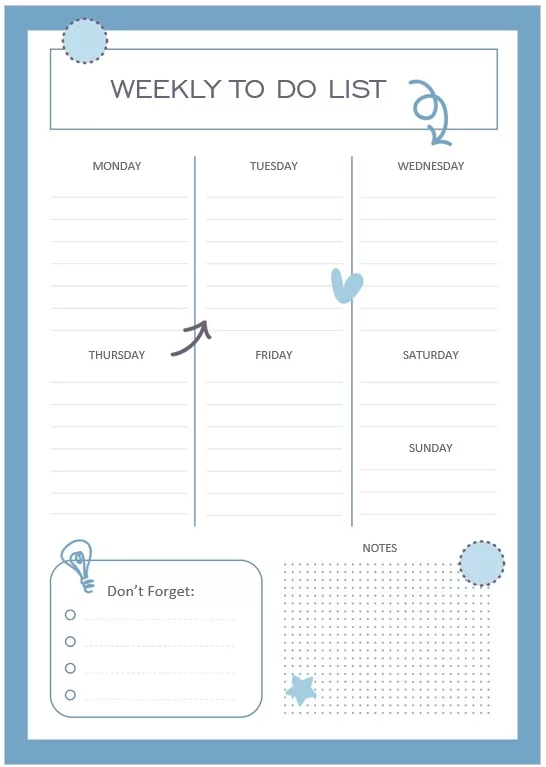
Click Here to Download
File Type: MS Word
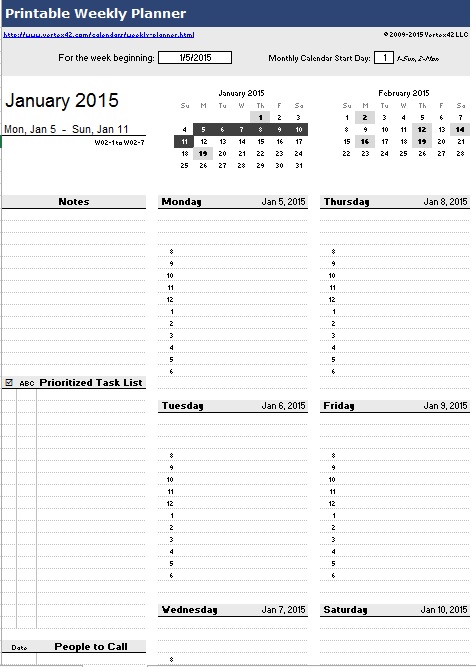
Click Here to Download
File Type: MS Word
Core Elements Every Effective Weekly Template Must Contain
A powerful weekly template isn’t a simple checklist; it’s a structured roadmap. The most reliable designs share four essential components:
- Header with Date Range & Primary Focus – The header should display the exact week (e.g., “Monday 3 Nov – Sunday 9 Nov”) and a concise theme or objective such as “Q3 Revenue Push” or “Family Health Week.” This entry point instantly aligns your subconscious with the week’s purpose.
- Tiered Priority Sections – Break the list into three levels: Must‑Achieve (critical deliverables that move core goals forward), Should‑Complete (important but not fatal if delayed), and Nice‑to‑Do (tasks that add value but can be shifted without impact. ) This hierarchy prevents the common trap of treating every item as equally urgent.
- Time‑Allocation Grid (or Block List) – Instead of a free‑form list, allocate each priority to a specific day and time slot. For example, “Tuesday 10 am – 12 pm: Draft Q3 sales pitch deck.” By marrying tasks with calendar entries, you eliminate the “when do I do this?” question and protect dedicated focus windows.
- Progress Indicator – A simple checkbox, a “Done/Deferred” toggle, or a visual bar that updates as the week progresses gives immediate feedback. Seeing half the week’s Must‑Achieve items ticked off creates momentum and a psychological boost that fuels further productivity.
A weekly to-do list can also serve as a motivation for individuals and businessmen. By using it they can set some goals that they can achieve in a specific time duration. Moreover, this document provides you with a road map to complete all the tasks efficiently and quickly within the given deadline.
Preparing a to-do list doesn’t require you to be an expert as with basic knowledge you can design for yourself. you can also have help from the samples and templates available on the internet. Starting with a blank document provides you more control over your document. To help you out, we have posted 10 free weekly to-do list templates below. These all templates are available in MS Word Format for ease of the users.

Click Here to Download
File Type: MS Word

Click Here to Download
File Type: MS Word

Click Here to Download
File Type: MS Word

Click Here to Download
File Type: MS Word
Four Proven Weekly Template Styles and When to Deploy Them
Here are four proven weekly styles of To Do List Templates that can change your life and increase productivity.
1. Goal‑Centric Weekly Planner
So the Week Plan method basically involves setting 2-3 important objectives for the week at the beginning and then disintegrating those objectives into measurable milestones that are assigned to specific days. The method is great for project managers, marketers, and anyone who has to meet quarterly OKRs. By linking everyday tasks to a broader aim, you don’t fall into the “busy work” trap and make sure that every action is meaningful.
2. Eisenhower‑Based Weekly Grid
The traditional urgent-important matrix is transformed into a seven-day timeline. Every single task is categorized into one of the four quadrants (Urgent-Important, Important-Not-Urgent, Urgent-Not-Important, and Neither) and then, the items from the first two quadrants are put into the calendar. This method is perfect for top management who simultaneously do strategic planning and put out fires, thus preventing the situation where urgent interruptions completely block important work.
3. “MC⁴D” (Must‑Can‑Delegate‑Delete) Weekly Sheet
Every single idea that comes to the mind of entrepreneurs usually feels like a very heavy burden. The MC⁴D template requires weekly triage to be performed at breakneck speed: write down each and every item, then classify it into one of four columns—Must be done this week, Can be done later, Delegate to a teammate, Delete because it adds no value. After the first sorting, only the “Must” column fills the time‑allocation part of the template. The adoption of this strategy leads to a significant decrease in mental burden and a rise in the culture of delegation.
4. Habit‑Stacking Weekly Tracker
When the emphasis is placed on self-improvement—exercise regimes, book reading targets, and language practice—a habit-stacking tracker comes to the fore. Write down each habit once, and then draw a straightforward matrix with the habit on the vertical axis and the days of the week on the horizontal axis. Indicate the cells you have finished, and by the end of the week, you can quickly identify the streaks and gaps. This visual indication makes the regularity firm, which is the driving force of the long-term success in the areas of health, skill acquiring, and lifestyle changes.

Click Here to Download
File Type: MS Excel
Benefits of a Weekly To-Do List:
This document makes things easier in life and assists the user in creating a schedule for completing all the tasks efficiently. If you have to Perform a lot of tasks in a week then a weekly planner is for you. If that’s the case then you should compulsorily use a weekly to-do list. It will divide your workload and will allow you to manage all the tasks efficiently.
Here we have listed some benefits of a weekly to-do list:
Reusability:
All you need to do is to draft a to-do list design. After that, you can use it anytime by updating it on your PC. Thus, you can craft a professional daily to-do list in no longer time.
Portray a clear image of the Entire Week:
It helps you to organize the tasks for the whole week. So you won’t miss crucial tasks, appointments meetings, etc. Furthermore, with a complete overview of your details tasks on the list, you can also measure the progress of specific tasks.
Creates a Structure:
A weekly to-do list enables you to form a structure for the work of a whole week. You can assign a time duration to each task. However, with editable features, you can make changes to your list according to the workflow and your responsibilities.
Connect Tasks with Objectives:
In the busy routine of each day, anyone can go away from the objectives of the work. however, this format will keep everyone on the same page by showing the task progress. Therefore, one can simply keep himself updated with work status.
Uses of a Weekly To-Do List:
A weekly to-do list helps you to perform all the things timely. By using this document you can produce desired results. Further, you should start creating a list of the most significant tasks of the day. If you have to miss anything for these tasks just miss it and focus on these tasks to achieve your weekly goals. Remember that the tasks and the goals are not the same things. Tasks are small parts of the work that you perform and the goals are objectives or milestones that you set to achieve in a defined period. While assigning the time duration to each task, it’s necessary to add the time for traveling that you will do to complete the work. In this way, you will manage your time efficiently without getting stressed.
With the help of it, you can easily plan and manage a complicated event by breaking down the work into small achievable chunks. It is very good for people who find it very difficult to plan their time or a project.
Nowadays, people use weekly to-do list templates to accomplish different tasks in a week. With the help of it, they can create a structure to perform difficult work efficiently.
Here you can find a list of tasks for which people often use a weekly to-do list:
Event Planning:
Weekly schedules can be used to organize meetings and assign assignments and tasks to subordinates and employees. For students, a weekly to-do list creates an ease to perform their homework, assignments, and projects that they have to complete within a given deadline. It helps them to manage everything timely.
Group Projects:
People working together on a large project need to have a structure that breaks down the whole work into small tasks. As we all know it is easy to achieve small tasks in a time duration instead of starting the work without knowing the starting point and going away from the right track. It often happens but you can save yourself and your team with the help of a weekly to-do list in which you can design a workflow by breaking down the work into small parts and assigning a time duration to each task. Thus, you can keep yourself and all the team members on board for finishing the project.