The fastest way to write an RFP is to start from a request proposal template, fill in its core sections (background, scope, requirements, evaluation criteria and submission rules), and publish it with a firm deadline and one named contact. The template in this guide is plain text, so you can paste it into Word or Google Docs and have a first draft in an hour. The five steps below tell you exactly what to write in each part.
Most weak RFPs fail for the same three reasons. The scope is vague, so every vendor prices a different project. The scoring rules are hidden, so you end up choosing on price or gut feel. The deadline is too tight, so the best vendors skip it. A blank page makes all three mistakes more likely, because you invent the structure while you are still working out what you need.
This guide covers the buyer side of the exchange: planning, drafting, publishing and scoring. You get a copy-ready template, a table explaining each section, a weighted scoring example with real numbers, and a sample timeline. Unique Printable is a free library of editable Word and Excel business templates, and its proposal collections serve the vendors who answer RFPs. This guide covers the other half of that exchange.
What an RFP template does and when you need one
A request for proposal (RFP) is a document that describes a project and asks vendors to bid on it. A template gives you the fixed skeleton, so you spend your time on the parts only you can write: the problem, the scope and the scoring rules.
What a request for proposal is, and what it is not
People search for a proposal request template, a request of proposal template or a template for a request for proposal, and all three mean the same document. The related documents in the table do different jobs, and picking the wrong one is a common early mistake.
| Document | What you ask vendors for | Use it when |
|---|---|---|
| RFI (request for information) | General information about what is possible | You do not yet know what solutions exist |
| RFQ (request for quotation) | A price for a clearly defined item or service | Specifications are fixed and price is the only variable |
| RFP (request for proposal) | A solution, a plan and a price | You know the problem but not the best way to solve it |
| IFB (invitation for bid) | A sealed bid, usually awarded to the lowest bidder | Public work with standard specifications |
Choose an RFP when the vendor’s approach matters as much as the price. If you only want to compare prices on an identical product, an RFQ is faster for everyone.
When an RFP is worth the effort
An RFP costs you a few days of drafting and costs each vendor days of response work, so use it for large, complex or risky purchases with several credible vendors. Skip it for small, repeatable buys, where three written quotes do the job. A good test: if switching vendors after signing would hurt for months, write an RFP.
Public agencies and many large organizations have their own procurement rules, and those rules override any generic template. Federal buyers, for example, follow the Federal Acquisition Regulation, which sets out how RFPs are built and how proposals are evaluated.
The RFP process in seven stages
Every RFP, from a $20,000 website rebuild to a municipal contract, moves through the same stages. The steps in this guide cover the stages in order.
- Define the need and the goals (Step 1).
- Draft the RFP from a template (Steps 2 and 3).
- Review it internally and issue it to vendors (Step 4).
- Run the question-and-answer period (Step 4).
- Evaluate the proposals against your criteria (Step 5).
- Shortlist, hold demos and negotiate (Step 5).
- Award the contract and notify every bidder (Step 5).
A template saves you the structure. The thinking about problem, scope and scoring is still yours.
Step 1. Define the need and gather your inputs
Before you open the template, write down the problem, the people involved and your hard limits. A few hours of preparation prevents weeks of vendor confusion later.
Write a one-sentence problem statement
Start with the problem, not the product. "We need a new scheduling system" invites every vendor to pitch its own system. "Our twelve technicians are scheduled by phone and spreadsheet, and we double-book about five jobs a week" invites real solutions. Add the outcome you want, such as zero double-bookings and one shared calendar.
Then list three to five measurable goals. "Cut scheduling time from ten hours a week to two" can be scored. "Improve efficiency" cannot. These goals become the background section of your RFP.
Pull in the people who sign off
Name the people who will use the result, pay for it and approve the contract. Typically that means the requester, someone from finance, someone from legal or contracts, and the end users. Ask each person the same question: what must be true for you to approve this? Surprise vetoes after proposals arrive are the most expensive mistake in the process, and an early conversation prevents them.
Appoint one owner who runs the RFP and one executive who makes the final call. Legal should read the terms, and IT or security should read any technical requirements before anything goes out.
Lock your budget, dates and decision rules
Collect these inputs before drafting, because the template asks for every one of them:

- Budget range or ceiling, and who approved it
- Latest acceptable start date and any hard deadlines
- Must-have requirements, separated from nice-to-haves
- The three to five people who will score proposals
- Whether you will publish openly or invite named vendors
- Contract basics: length, payment schedule, insurance and confidentiality
On budget, take a position: share a range or a ceiling. Vendors who see no number price at random, and you spend your review time on bids that were never going to fit.
Write the problem you have, not the product you think will solve it.
Step 2. Build the RFP from the template
Copy the template below into a new document and replace every bracket. The structure follows the five parts every RFP needs (background, scope, requirements, evaluation criteria and submission instructions), plus the logistics that keep the process clean.
Copy the request for proposal template
This is what an RFP template looks like in practice. Paste it into Word or Google Docs, then fill each bracket with your own details.
REQUEST FOR PROPOSAL (RFP)
Project: [Project name]
RFP number: [Number or reference]
Issued by: [Organization name]
Issue date: [Month Day, Year]
Deadline for questions: [Date, 5:00 p.m. local time]
Proposal deadline: [Date, time, time zone]
Contact: [Name, title, email, phone]

1. INTRODUCTION AND PURPOSE
[Two or three sentences: who you are, what you are buying, and what you want vendors to do.]

2. ABOUT [ORGANIZATION]
[Short profile: what you do, size, locations, and anything that affects the work.]

3. PROJECT BACKGROUND AND GOALS
[The problem today, what has been tried, and the outcomes you want. List 3 to 5 measurable goals.]

4. SCOPE OF WORK AND DELIVERABLES
[What the vendor must do, what is out of scope, and each deliverable with its due date.]

5. REQUIREMENTS
Must have:
- [Requirement]
Nice to have:
- [Requirement]

6. TIMELINE
[Issue date, question deadline, answer date, proposal deadline, finalist presentations, decision date, project start.]

7. BUDGET
[Budget range or ceiling, and how prices must be shown: fixed fee, hourly rate, or itemized.]

8. VENDOR QUALIFICATIONS
[Required experience, licenses, insurance, certifications, and the number of references to supply.]

9. PROPOSAL FORMAT AND SUBMISSION
[Required sections, page limit, file type, and exactly how and where to submit.]

10. EVALUATION CRITERIA
[List each criterion with its weight. Weights total 100%.]

11. TERMS AND CONDITIONS
[Contract length, payment terms, confidentiality, ownership of work, termination, and your right to reject all proposals.]

12. CONTACT AND QUESTIONS
[One point of contact. All questions in writing. Answers shared with every vendor.]
What each section must do
Each section has one job. The table shows that job and the mistake that most often undermines it.
| Section | Its job | Common mistake |
|---|---|---|
| Introduction and background | Lets a vendor decide in 30 seconds whether to bid | Writing a company history instead of the problem |
| Scope and deliverables | Makes every vendor price the same project | Leaving out what is not included |
| Requirements | Separates must-haves from nice-to-haves | Listing 60 "must haves" |
| Timeline and budget | Lets vendors plan staff and shape their price | Hiding the budget |
| Evaluation criteria | Shows how you will choose | Naming criteria but no weights |
| Submission rules | Makes proposals easy to compare | Allowing any format |
| Terms | Sets contract expectations up front | Springing new terms on the winner |
Most RFPs run roughly five to ten pages. Complex projects run longer, but if yours passes twenty pages, check whether the requirements section is doing the work of a contract.
Format it for Word, Google Docs or PDF
Paste the template into Word and apply Heading styles to the numbered titles. You then get a navigation pane and an automatic table of contents. In Google Docs, paste it and use the same heading styles. For US readers, set the page size to Letter under Layout, then Size, and add the RFP number and page numbers in the header or footer.
Save the finished file as a master copy and use Save As for each new project. Send vendors a PDF so the layout cannot shift, but keep the Word version, because you will need it for addenda.
Every bracket you leave unfilled becomes a question from a vendor, so fill them all.
Step 3. Write requirements and scoring criteria
Requirements and scoring criteria are the two parts of an RFP that decide the quality of the bids you receive. Spend more of your drafting time here than anywhere else. A request for proposal template gives you the headings, but the content under these two headings is what vendors actually respond to.
Write requirements vendors can answer
A good requirement is specific enough that a vendor can answer yes, no or partly, and you can verify the answer. Split the list into must-haves and nice-to-haves, and keep must-haves to the items that would make the result unusable if missing. Compare these examples:
| Vague | Specific |
|---|---|
| Reliable support | Phone and email support from 8 a.m. to 6 p.m. Eastern, with a four-hour response to urgent issues |
| Secure system | Data encrypted in transit and at rest, with a written description of the vendor’s security practices |
| Fast delivery | Launch within 90 days of contract signature, with milestone dates in the proposal |
| Experienced team | At least three completed projects of similar size in the last five years, with references |
Set weighted scoring criteria
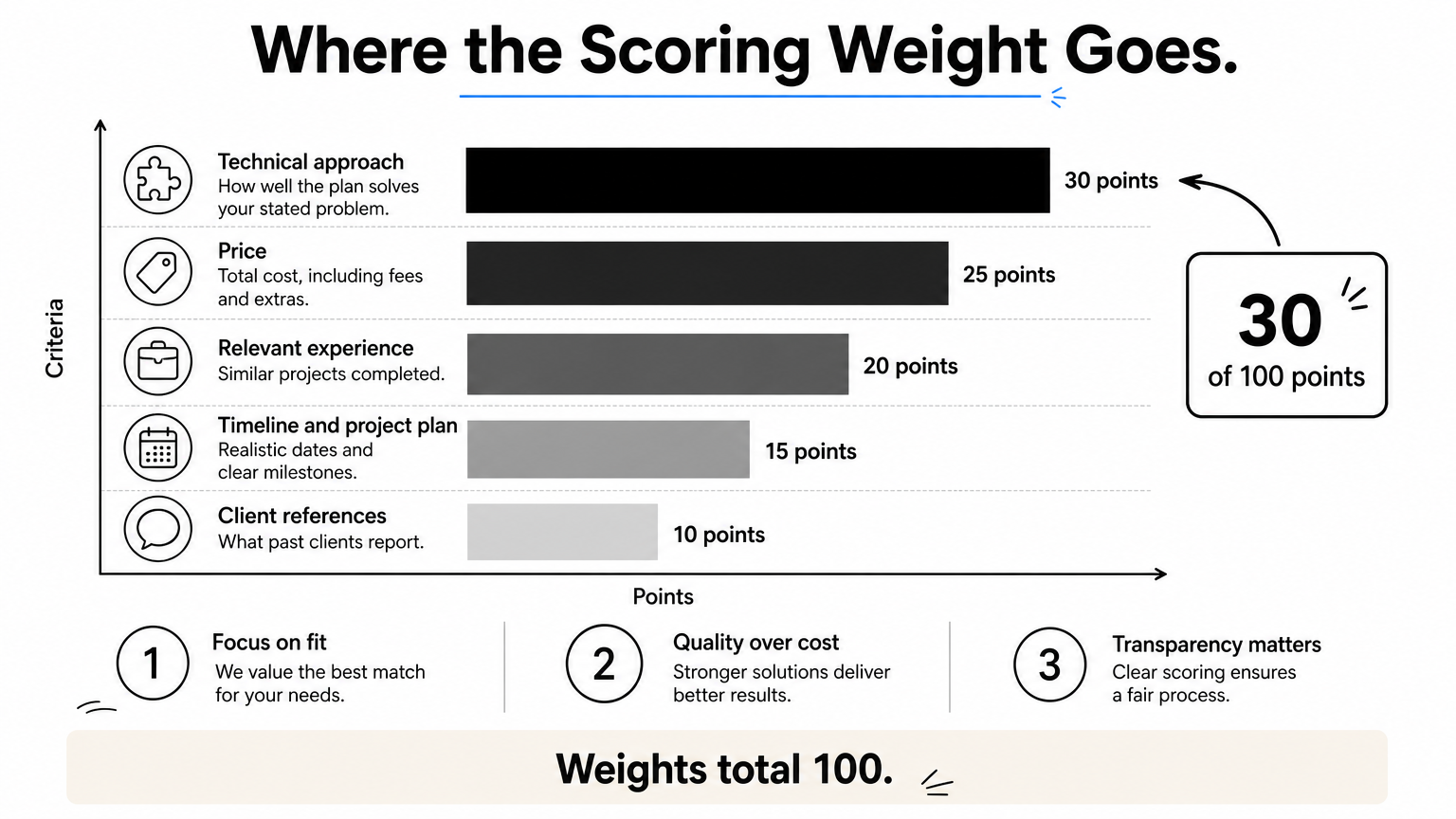
State your scoring criteria and their weights inside the RFP. Vendors then spend effort on what you care about, and your decision can be defended later. Weights should total 100, and no single criterion should be so small that it never changes the outcome. This split suits many service projects:
| Criterion | Weight | What it measures |
|---|---|---|
| Technical approach | 30 | How well the plan solves your stated problem |
| Price | 25 | Total cost, including fees and extras |
| Relevant experience | 20 | Similar projects completed |
| Timeline and project plan | 15 | Realistic dates and clear milestones |
| References | 10 | What past clients report |
Adjust the weights to your project. A safety-critical purchase should weight approach and experience higher, while a commodity purchase can weight price higher. Publishing the weights keeps you honest, because you cannot change them after seeing the bids.
Tell vendors what to include in their response
Prescribe the response format so proposals line up side by side. Ask each vendor for:
- An executive summary of no more than one page
- Their approach and work plan, mapped to your scope
- A timeline with milestones
- Team members and their relevant experience
- Three references with contact details
- Pricing in your required format, with any extra fees listed
- Any exceptions to your terms and conditions
If you are on the other side of the table and need to answer an RFP like this, the Free Govt. Project Proposal Templates on Unique Printable are a ready structure. The set has 10 MS Word templates covering tender responses, technical and financial submissions, grant applications and capability statements. One rule applies in every case: where an authority specifies a format, that format overrides any template.
If you will not score a requirement, delete it. Every extra line makes bids longer and harder to compare.
Step 4. Review, publish and answer questions
Once the draft is complete, check it, set realistic dates, and send it out in a way that treats every vendor equally. This stage turns your request for proposal template into a live procurement, so the discipline matters more than the formatting.
Set a realistic timeline
Give vendors enough time to write a good response. Two weeks is the minimum for a simple project, three to four weeks suits most projects, and complex work needs more. Rushed deadlines cost you the busiest and often the best vendors. This sample schedule works for a mid-sized service project:
| Day | Milestone |
|---|---|
| 0 | RFP issued |
| 7 | Deadline for written questions |
| 10 | Answers sent to every vendor in one addendum |
| 21 | Proposals due |
| 24 to 28 | Finalist presentations or demos |
| 32 | Decision announced |
| 45 | Target date for a signed contract |
Review it before it goes out
Run a final check with people who did not write it. Have legal read the terms, finance confirm the budget figure, and one person unfamiliar with the project read the whole RFP cold. If that reader cannot explain the project back to you, vendors will struggle too.
Use this checklist:
- Every date is correct and every deadline includes a time zone
- The scope states what is out of scope as well as what is in
- Each requirement is something you intend to score
- Weights add up to 100
- Only one contact person is named
- Page numbers and the RFP number appear on every page
Publish and manage questions
Send the RFP to the vendors on your list, or post it publicly if you want the widest field. A closed list of three to six vetted vendors is faster to run. An open posting finds vendors you did not know existed. Either way, take all questions in writing and send every answer to every vendor, with the question text but without naming who asked.
Hold a short pre-proposal call if the project is complex, and record the same answers in an addendum afterward. Do not have side conversations with individual vendors, because one private answer can undermine the whole process.
Fairness is the point of an RFP. Every vendor gets the same information at the same time.
Step 5. Score proposals and choose a vendor
Score every proposal against the criteria you published, with each reviewer working alone first. Then meet to compare results, discuss large gaps, and pick finalists. A structured process is what separates an RFP from a collection of price quotes.
Score independently, then compare
Give each reviewer the same scorecard and ask for scores before any group discussion. This prevents the loudest voice from setting the result. Rate each non-price criterion from 1 to 5 and convert it to points by multiplying the rating divided by 5 by the weight. Score price with a formula: lowest bid divided by the vendor’s bid, times 25.
Here is a worked example with three bids of $52,000 (Vendor A), $48,000 (Vendor B) and $60,000 (Vendor C). Vendor B’s price points are 25 because it is the lowest. Vendor A gets 48,000 ÷ 52,000 × 25, which is 23.1. Vendor C gets 48,000 ÷ 60,000 × 25, which is 20.
| Criterion (weight) | Vendor A | Vendor B | Vendor C |
|---|---|---|---|
| Technical approach (30) | 24 | 24 | 30 |
| Relevant experience (20) | 20 | 12 | 16 |
| Price (25) | 23.1 | 25 | 20 |
| Timeline and plan (15) | 12 | 9 | 15 |
| References (10) | 8 | 6 | 10 |
| Total (100) | 87.1 | 76.0 | 91.0 |
The cheapest bid finishes last and the most expensive wins. That result is exactly why you weight criteria instead of picking the lowest number.
Shortlist, clarify and negotiate
Take the top two or three scorers to a second round. Ask them to present their plan to the people who will work with them, and call the references they listed. Ask what went wrong on the project, not just what went right. A vendor who can describe a problem and how they fixed it is usually more reliable than one with only glowing stories.

Negotiate with your top choice on scope details, milestones and payment terms. Keep your second choice warm until the contract is signed.
Award the contract and close out
Notify the winner in writing, then tell every other bidder promptly and offer a short debrief. Vendors remember how you treated them, and the good ones will bid on your next RFP. Draft the contract from the proposal and your RFP terms, and make sure the winning vendor’s promises appear in it.
Finally, update your master template with what you learned. Add the question every vendor asked, tighten the requirement that caused confusion, and note the timeline that worked. Your next RFP will be faster and clearer.
Score against the weights you published, and the winner will be easy to justify.
Your RFP, ready to send
An RFP works when it names the problem, defines the scope, states the scoring rules and gives vendors enough time to respond. The template above gives you the structure. The five steps give you the content: define the need, build the document, write measurable requirements and weights, publish fairly, and score every bid against the same scorecard. Do those and you will compare like with like, whichever vendors respond.
Save your finished RFP as a master copy so the next one starts from your own proven version. If you also write proposals for clients, or need invoices, quotations and schedules around the same project, browse the free editable proposal templates at Unique Printable. They are Word and Excel files with no sign-up required.