To write a proposal for a business, research the client, then build the document in a fixed order: cover page, executive summary, problem, solution, pricing, proof of ability, and terms with a signature line. Keep every part short, aim it at one client’s problem, and end with a clear next step. This guide gives you five steps and sample wording for each part, so you can adapt text instead of staring at a blank page.
Most proposals lose for the same reasons. They talk about the sender instead of the buyer, they bury the price, or they end without asking for a decision. A business to business proposal also has a harder audience than a consumer pitch. Several people at the client company read it for different reasons, and the busiest of them read only the first page.
Unique Printable publishes free, editable proposal templates in Word, so this guide works with any of them or with a blank document. First you will see what a proposal is and what it is not. Then five steps take you from research to a signed, followed-up proposal, with a worked pricing example along the way.
What a business proposal is and what you need first
A business proposal is a document you send to a prospective client to show that you understand their problem and to offer your solution, price and terms, so they can say yes. It is written for one reader and one decision. Anything that does not help that decision does not belong in it.
Solicited, unsolicited and business to business proposals
A solicited proposal answers a request. Formal requests arrive as an RFP, where several vendors compete against the client’s stated requirements. Informal ones come out of a call or meeting, when the client says "send me something." An unsolicited proposal is one you send first. It needs more research, because nobody has told you what the problem is.
A business to business proposal adds one complication: your reader is a group. The person who feels the problem wants results, the person who controls the budget looks for the total and the return, and someone in operations or legal checks the timeline and terms. Write the summary for the first two readers and the later sections for the third.
How a proposal differs from related documents
Clients and vendors mix up these documents constantly, and sending the wrong one wastes both sides’ time. The table shows which is which.
| Document | What it does | Who starts it |
|---|---|---|
| Business proposal | Argues for your solution with problem, plan, price and terms | You, or the client through an RFP |
| Quotation or estimate | States a price for a defined job, usually on one page | The client (RFQ) or you |
| Business plan | Describes how your own company will grow and be funded | You, for internal use or investors |
| RFI | Asks vendors for general information before any proposal | The client |
| RFP | Asks for a full formal proposal | The client |
| RFQ | Asks for prices on standard goods or services | The client |
If a client sends an RFP, answer with a full proposal. If they send an RFQ, a one-page quotation is enough, and a long proposal only shows you did not read the request.
A proposal argues for a solution, while a quotation only states a price.
What to have ready before you start
Gather the inputs first, because gaps show up halfway through the draft and stall you. You need:
- The client’s legal name, your contact’s name and title, and who else will read the document.
- The brief, email thread or meeting notes that describe the problem.
- Your pricing basis: a fixed fee, an hourly or day rate, or itemized costs.
- Two or three examples of relevant past work, with a result you can state.
- Your logo, brand colors and contact details.
- Your page size. For a US client, set the document to US Letter.
Step 1. Research the client and choose a format
Spend your first hour on the client, not on writing. Find the problem in their words, the people who decide, the budget range and the deadline, then pick a section order. Everything you write later depends on these answers.
Collect the facts the proposal will use
Answer six questions before you open a document: What is the problem, in the client’s own words? What does it cost them today in money, hours or lost customers? Who signs off? What budget range are they working with? When must it be done? How will they choose between vendors?

For a solicited proposal, read the brief line by line and mirror its headings. If it prescribes a format, that format beats any template. For an unsolicited proposal, read the client’s website, recent announcements and job postings to spot problems, then ask for a short call. A fifteen-minute conversation tells you more than an hour of guessing.
Use a standard proposal format for business
This proposal format for business works for almost any service or product sale. Each section has one job, and the total lands at roughly 6 to 8 pages, which is enough to persuade without wearing the reader out.
| Section | Its job | Typical length |
|---|---|---|
| Cover page | Name the result, the parties and the date | 1 page |
| Executive summary | State problem, solution and why you | Half to 1 page |
| Problem statement | Prove you understand the situation | Half to 1 page |
| Proposed solution | List deliverables, method and milestones | 1 to 2 pages |
| Timeline | Give dates for each milestone | Half page |
| Pricing | Itemize costs and payment schedule | 1 page |
| Qualifications | Offer proof that you can deliver | Half page |
| Terms and acceptance | Set the rules and collect a signature | 1 page |
Give each section exactly one job, and cut any sentence that does not serve it.
Start from a template that matches your purpose
A good business proposal template saves you the structure work, so you only supply client-specific content. Pick the one that matches what you are asking for. Unique Printable offers these Word sets, each free:
| If you want to… | Template set |
|---|---|
| Put an opportunity in front of a funder, partner or approver | Free Business Venture Proposal Templates (10) |
| Ask an investor for capital | Free Investment Proposal Templates (10) |
| Raise support for an event, club, conference or charity | Free Sponsorship Proposal Templates (10) |
| Bid for public-sector work | Free Govt. Project Proposal Templates (10) |
| Win a building job | Free Construction Proposal Templates (10+) |
| Sell development work to a client | Free Software Development Proposal Templates (10) |
| Bid for haulage, bus or logistics contracts | Free Transportation Proposal Templates (10) |
| Pitch or plan a development | Free Land Development Proposal Templates (10) |
You can add your own branding and use them commercially, but you cannot resell the files themselves. They are set to A4 by default, so switch to US Letter through Page Setup. To edit in Google Docs, upload the .docx file to Google Drive, right-click it and choose Open with, then Google Docs.
Step 2. Write the cover page and executive summary
The cover page names the result you will deliver, and the executive summary states the problem, your solution and why you in under 200 words. Together they are the only part many readers finish, so they carry the most weight.
Build a cover page that names the result
Put five things on the page: the proposal title, the client’s name, your company name and contact details, the submission date, and optionally a "valid until" date. The title does the persuading. "Business Proposal" tells the reader nothing, while a title built as result plus client tells them what they get.

- Weak: Business Proposal
- Strong: A Faster Online Ordering System for Tanner Supply
Keep the title under 12 words and skip jargon. Use your logo once, in a corner, and leave the rest of the page clear.
Write the executive summary after the body
Write this part last even though it appears first. By then you know exactly what you are promising, and a summary written early drifts away from the body. Cover three things in three short paragraphs: the client’s problem, your solution with the fee and timeframe, and one specific reason to trust you.
Copy this structure and fill the brackets:
Executive summary

[Client name] needs [problem in one sentence, using the client's words]. Left unsolved, this [cost: lost revenue, wasted hours or risk].

[Your company] proposes [solution in one sentence]. Over [timeframe], we will deliver [deliverable 1], [deliverable 2] and [deliverable 3] for a fixed fee of [amount].

We are the right team because [one specific proof: years in the field, relevant work or certification]. We can start on [date] and ask you to confirm by [date].
Here is a filled-in version, using a made-up web studio called Brightline Studio:
Tanner Supply loses reorders because customers must phone or email to buy, and the sales team spends about 15 hours a week typing those orders in by hand. Brightline Studio proposes an online ordering site connected to your inventory spreadsheet. Over 12 weeks we will deliver a mapped workflow, an approved design, a tested site and staff training for a fixed fee of $15,000. We have built ordering sites for wholesale distributors for six years and can start on March 3. Please confirm by February 21.
Notice the summary contains a number, a date and a decision request. A summary that says "we are passionate about quality" contains none of these, which is why it fails.
If a reader stops after the executive summary, they should still know what you offer, what it costs and what to do next.
Step 3. Define the problem and your solution
Describe the client’s problem with one measurable figure, then present your solution as named deliverables with milestones, not promises. This is the longest part of any proposal for a business, and it is where readers decide whether you understood them.
Write a problem statement the client would sign
A good problem statement is something the client reads and thinks, "yes, that is exactly it." Use their language from the brief or your call. State the current situation, the cost, and one issue they may not have noticed, such as a dependency or a risk. Keep it to two or three short paragraphs.
Avoid emotional pressure and long market statistics. One accurate number about this client beats ten about their industry.
The problem
[Client name] currently [describe the situation in one sentence]. This means [measurable consequence: hours, dollars or lost customers each week or month].

Two factors make this harder to fix: [factor 1], and [a factor the client may not have noticed].

The goal is [specific outcome with a number and a date].
Turn the solution into deliverables and milestones
Name what the client receives at each stage, and avoid statements like "we will provide support." A deliverable is a noun the client can check off, such as a design approved by them or a site tested with ten accounts. Tie each phase to an approval point, so both sides know when a phase is done.
Here is the Brightline example laid out as a deliverables table:
| Phase | What the client receives | Weeks |
|---|---|---|
| Discovery | Ordering workflow map, product data audit, signed-off requirements | 1 to 2 |
| Design | Mockups of catalog, cart and checkout, approved by Tanner Supply | 3 to 5 |
| Build | Working ordering site linked to the inventory spreadsheet, tested with 10 real customer accounts | 6 to 10 |
| Launch and training | Live site, one-hour staff training, 30-day bug-fix window | 11 to 12 |
Add two short lists under the table. One covers what you need from the client, such as product data, a named contact and feedback within three business days. The other covers what is out of scope, such as photography or ongoing hosting. Stating exclusions now prevents disputes later.
Name every deliverable as something the client can check off, and tie each to an approval point.
Step 4. Price the work and prove you can deliver
Show pricing as itemized phases that add up to one clear total, then back it with two or three pieces of proof that fit this client. Readers who understand the price trust you more, and proof is what makes the price feel safe to accept.
Present pricing so the total is obvious
Price according to how you actually charge: a fixed fee, a day rate or itemized costs. Whatever you choose, show the breakdown so the client sees what they are paying for. Pricing too low can make the job unprofitable for you, and pricing too high sends the client to a competitor, so base it on your costs and the budget range you learned in Step 1.
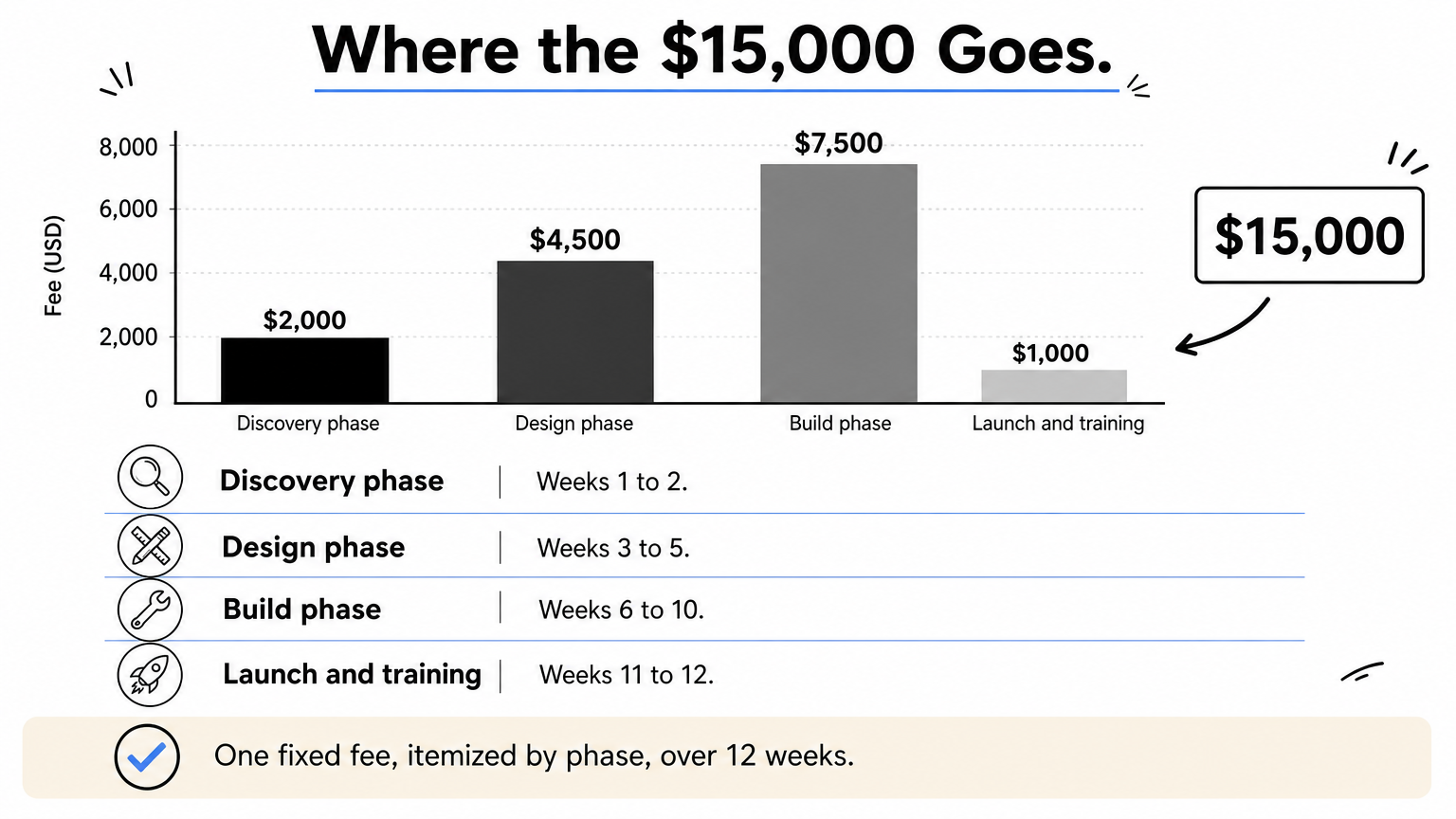
Here is the Brightline fee table:
| Phase | Weeks | Fee |
|---|---|---|
| Discovery | 1 to 2 | $2,000 |
| Design | 3 to 5 | $4,500 |
| Build | 6 to 10 | $7,500 |
| Launch and training | 11 to 12 | $1,000 |
| Total | 12 | $15,000 |
Tie payments to milestones: 40% on signing ($6,000), 30% when the design is approved ($4,500) and 30% at launch ($4,500), which adds up to the same $15,000. List optional extras separately, such as ongoing support at $400 per month after launch, so the client can see the core price without it. Finish with a validity period, such as "this pricing is valid for 30 days."
Show prices as itemized phases that add up to one clear total.
Show qualifications that match this client
Qualifications answer one question: why should this client trust you with this job? Pick evidence that fits their situation instead of listing everything you have done. Useful items include:
- One or two past projects like theirs, each with a result you can state in numbers.
- Certifications or licenses the work requires.
- The named people who will do the work, with their roles and relevant years of experience.
- References the client may contact, with their permission.
If your business is new, lean on the track record of the people involved, a small paid pilot, or relevant certifications. Do not pad the section with generic phrases like "we are passionate about quality." Half a page of specific proof is better than two pages of adjectives.
Step 5. Add terms, close the proposal and follow up
End with plain-language terms, an acceptance block and a follow-up date, then send the proposal as a PDF and check in within a few days. A proposal that does not ask for a decision usually gets none.
Cover the terms in plain language
Terms set what each side can expect, and they cut the risk of arguments mid-project. Keep them to one page and cover:
- Payment schedule, accepted methods and late-payment fees.
- How changes to scope are requested, priced and approved.
- Who owns the finished work and when ownership transfers.
- Confidentiality of information shared during the project.
- Cancellation terms and what happens to fees already paid.
- The date until which the proposal and its pricing are valid.
For large or unusual contracts, have a lawyer review the terms. This guide is general information, not legal advice. Then add an acceptance block, because making it easy to sign makes a yes more likely.
Acceptance

By signing below, [Client name] accepts this proposal and its terms, valid until [date].

Client signature: ______________________   Date: ____________
Name and title: ________________________

[Your company] signature: ______________   Date: ____________
Name and title: ________________________
Proofread, send and follow up
Check names, figures and dates before sending. Confirm the client’s name is spelled right everywhere, the fees add up to the stated total, and the dates match the timeline. If you use an AI assistant for a first draft, treat it as a starting point. It can suggest structure and wording, but it does not know your client’s problem, your prices or your track record, and it may invent numbers. Give it your notes, then verify every figure yourself.
Save the file as a PDF with a clear name, such as Brightline-Studio-Proposal-Tanner-Supply.pdf, and send it with a short email. If you hear nothing in three to five business days, follow up. Keep the message friendly and specific:
Subject: Following up on the Tanner Supply ordering site proposal

Hi [Name],

I wanted to check that the proposal I sent on [date] reached you. It covers the 12-week plan, the fixed fee and the start date of [date].

Do you have questions I can answer, or anything you would like me to adjust? I am happy to walk through it in a 15-minute call.

Thanks,
[Your name]
[Phone number]
Send the proposal with a clear next step, and follow up within a week.
Send your proposal with confidence
A strong proposal for a business is built, not improvised. You research the client, open with a cover page and summary that name the result, define the problem and solution in concrete deliverables, price the work in itemized phases, prove you can deliver, and close with simple terms and a signature block. Each step has one job, and each part should be short enough that a busy reader finishes it.
Reuse what you wrote. Once one proposal works, keep it as a master copy and save a new version for each client, changing the problem, deliverables, prices and proof. If you want a structured starting point, the free Word proposal templates at Unique Printable cover everything from sponsorship and investment to construction and software, with every section editable.